New Bern, North Carolina
Kitchen remodeling in historic New Bern homes
In New Bern's local historic districts, the city reviews changes to the outside of your home. Kitchen work inside is generally not part of that review, but a new window or wall vent can be. Call now to talk through your house with a local kitchen remodeler.
Know your district
Four historic districts, two with local rules
New Bern has four districts on the National Register of Historic Places: Downtown, Riverside, Ghent and DeGraffenried Park. Only Downtown and Riverside are local historic districts, and those are the two where the city has legal control over exterior changes. The rules are run by the City's Historic Preservation Commission, not by the New Bern Historical Society, which is a common mix-up.
Each neighborhood has its own kind of house. Downtown holds the oldest homes in a town founded in 1710. Riverside covers about 15 blocks along the Neuse. It grew out of subdivisions laid out in 1894 and 1912 and became the city's first suburb. Ghent developed as a residential neighborhood from about 1912 to 1941, so expect bungalows and early 20th-century kitchens that were small to begin with.
Being on the National Register alone does not add city review. If you are unsure which applies, the City publishes a map of the local districts on its historic preservation page, and staff can check your address.
Where the line falls
What historic review means for a kitchen
The city says plainly that its historic guidelines apply to exterior changes. So the question is whether your kitchen plan reaches the outside of the house.
| Kitchen work | Touches the exterior? | What to do |
|---|---|---|
| Cabinets, counters, sink, floors, paint | No | Historic review is generally not involved |
| Moving a wall inside the house | No | Check structure and building permits |
| Adding or resizing a window over the sink | Yes | Ask about a Certificate of Appropriateness first |
| New range hood vent through a wall | Yes | Ask about placement before ordering the hood |
| Adding a back door or porch to the kitchen | Yes | Expect review, and allow time for it |
Some changes count as in-kind replacement or minor work and can be approved by city staff. Others go before the Commission. Call the administrator at (252) 639-7583 before you settle on a plan. Starting first is the expensive way to do this: the City's listed fee for after-the-fact approval is higher than the fee for applying ahead of time.
Behind the walls
What to ask about an old New Bern house
- Lead paint. For homes built before 1978, anyone paid to disturb painted surfaces must be certified in lead-safe work practices under the EPA's rule. Ask to see that certificate.
- Old wiring. A kitchen draws more power than the house was ever built for. Ask whether the panel can take new circuits, and whether any older wiring needs replacing while the walls are open.
- Floors that are not level. Old houses settle. New cabinets have to be shimmed or scribed to fit, and that takes time. Ask how the installer will handle it.
- Crawl space moisture. Ask someone to look under the kitchen for damp wood before new cabinets go on top of it, especially on a low lot near the river.
- Original features. Tall windows, plaster, heart-pine floors and built-ins are hard to replace. Decide what stays before the demolition starts.
In keeping with the house
Designing a kitchen an old house can wear
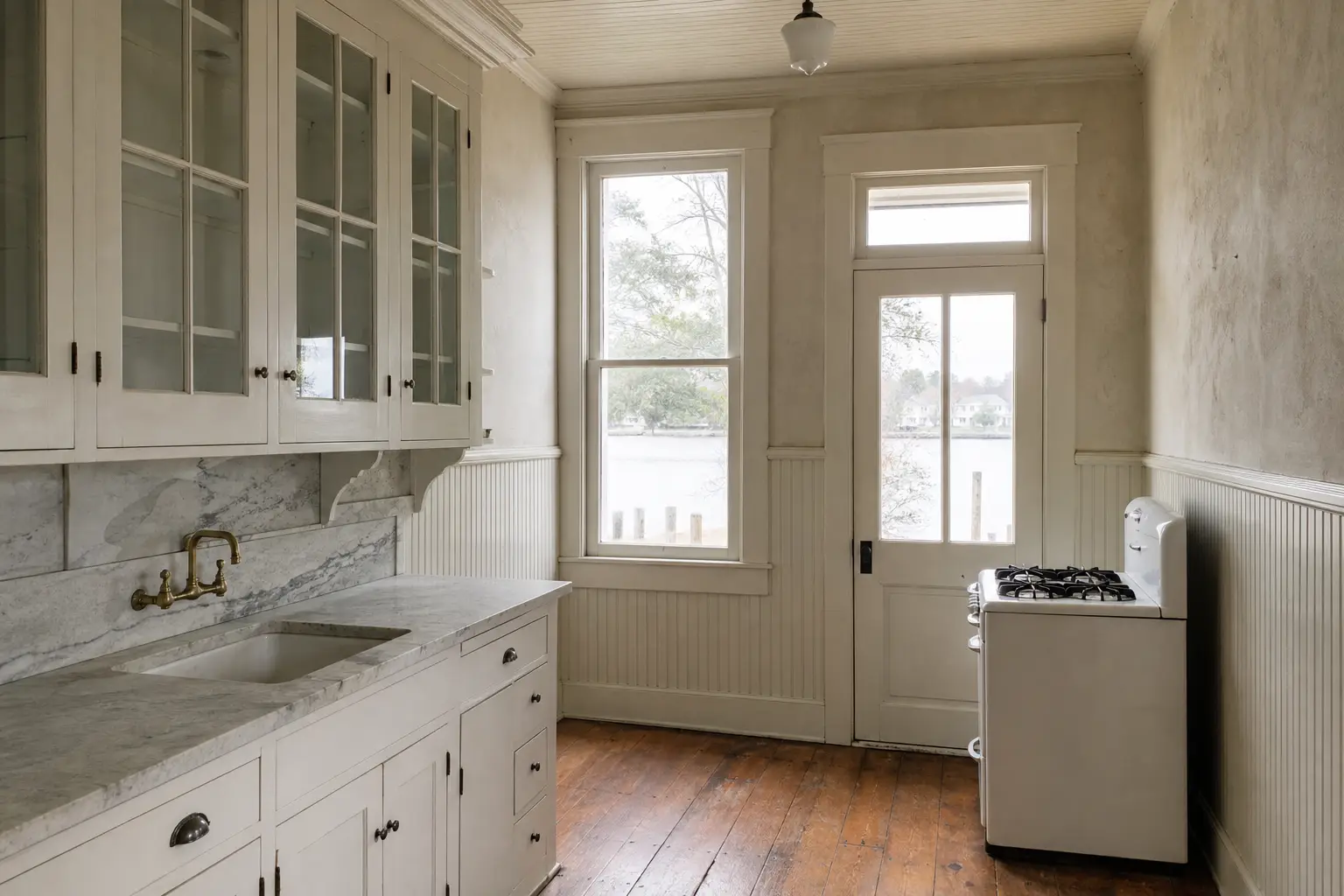
Kitchens in early homes were service rooms, often small and at the back. Few owners want to keep them exactly as they were. The usual goal is a kitchen that works today and still feels like it belongs to the house.
Choose inset or simple flat-panel doors. Inset cabinet doors sit flush in the frame, the way older built-ins do. They cost more than overlay doors, and in humid weather they need careful fitting.
Keep the height. Tall ceilings are a gift. Cabinets that run to the ceiling store more and read as built-ins. A window left at its original height keeps the room honest.
Use materials that age. Soapstone, marble, unlacquered brass and painted wood all pick up wear. In a house like this, that tends to look right.
Hide what is new. Panel-front refrigerators and dishwashers, and a plain plaster hood, keep the appliances from taking over the room.
Common questions
Do I need city approval to remodel a kitchen in a New Bern historic district?
For interior cabinets, counters and finishes, generally no historic approval applies, because the city's guidelines cover exterior changes. Building, electrical and plumbing permits still apply. Anything that changes the outside of the house needs a Certificate of Appropriateness, so ask before you plan around a new window or vent.
Who do I call about historic district rules?
The City of New Bern's Historic Preservation Commission staff, at (252) 639-7583 or [email protected]. They can tell you whether your change is minor work that staff can approve.
Is Ghent a local historic district?
Ghent is on the National Register of Historic Places but, according to the New Bern Historical Society, it is not one of the two local historic districts. Check your address with the City, since district lines can be specific.
Does a remodel have to use period materials?
Not on the inside, as far as historic review goes. Interior finish choices are yours. Many owners still pick traditional materials because they suit the house.